Outline of Environmental and Social Impact Assessment Report
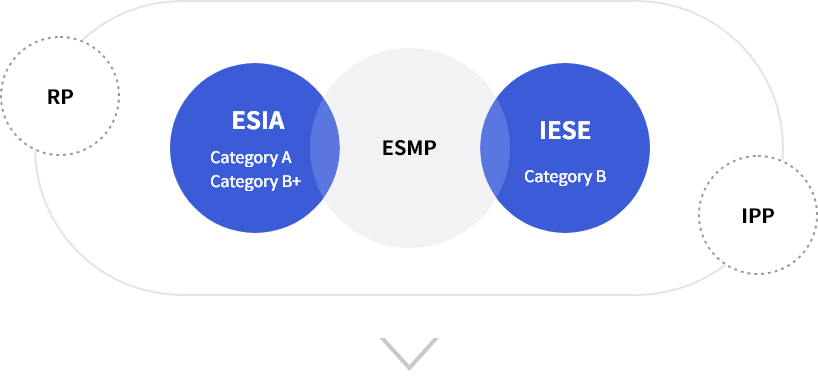
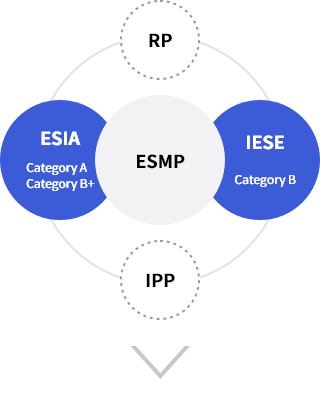
The ESIA report is a comprehensive assessment of evaluation criteria and consultations among local residents and governments which identify the significance of environmental and social impacts caused by the project and thoroughly examine key issues while providing coverage of less important but related issues. The assessment report should be objective and logical, be based on appropriate scientific data of natural, social, and applied science. The ESIA report includes the rationale for the following : survey regions and locations; the methodology, conditions and statistics used for impact predictions. If the laws and regulations are referred to in the assessment report that require verification, a brief description of such laws and regulations or a copy of the related documents that verify their legitimacy should be provided. Terminology used in the assessment document should be explained in layman’s terms.
1. Executive Summary
2. Outline of Project : This section describes the background, purpose, and need for a project. The project's title, site, and operator should also be included. Maps marked with the location of the project site should be provided. The project period, budget, scale (e.g., area, population, routes), and anticipated effects should be clearly described.
3. Environmental Setting of Project Area : This section provides information on :
- Land use within and in close proximity to the project area.
- The present state of environmental and social preservation areas designated by laws or regulations.
- The present state of endangered species, protected wildlife, vegetation, and migrating birds.
- Major facilities such as plants, airports, roads, or railroads that might have adverse environmental impacts.
- Cultural assets and natural treasures, historically or culturally valuable construction, and historic or archeological sites.
- Environmental infrastructure such as sewage and waste disposal facilities.
- Traffic within the vicinity of the project site and plans for expansion of road infrastructure.
- Public facilities including schools and hospitals.
- The present state of displaced persons and indigenous peoples.
- Other environment related issues in the project area.
4. Examination of Current Environmental and Social Conditions : This section specifies the results of examination of environmental and social conditions. In principle, examination should be conducted through a field survey, but it may also be conducted using documents, literature, and databases on the respective environment and society, if they are available. In such cases, the latest information should be used and sources should be cited. In case information on the environment and society is managed by an administrative district, the examination should cover the administrative district pertaining to the project site.
5. Prediction & Assessment :This section provides the impact prediction and analysis processes.
It should be carried out before and after implementation of mitigation measures for current environmental and social conditions after project implementation.
The borrower shall evaluate impact predictions and analysis with regard for human health, the living environment, environmental conservation, and socioeconomic impacts.
The impact assessment should be evaluated against current environmental and social standards, scientific knowledge, experiences, and other criteria used widely overseas.
6. Mitigation Measures for the Environmental and Social Impacts :This section assesses the adequacy of mitigation measures for environmental and social impacts.
It should be developed logically and accurately based on current environmental and social conditions as well as predictions and analyses of potential impacts and should avoid mere enumeration of general academic and technical information.
The advantages and disadvantages of more than two alternatives should be presented objectively in the impact assessment report.
Finally, mitigation measures to be implemented after the project is initiated should be selected and proposed and their rationale should be provided.
7. Inevitable Environmental and Social Impacts and Mitigation Measures :This section provides any adverse environmental and social impacts that cannot be adequately mitigated; these issues should each be analyzed and presented.
8. Alternatives and Evaluation :This section provides information on alternatives and evaluation.
The borrower should establish alternatives to the project plan and conduct an analysis and evaluation of each of those alternatives.
9. Information Disclosure, Consultation, and Participation :This section describes the information disclosure and consultation process for the people affected by the project.
It summarizes the comments and concerns received from stakeholders and how these comments and concerns are reflected in the project design and mitigation measures.
The ESIA report also includes a grievance redress mechanism through which local residents can file a civil petition.
10. Local Grievance Redress Mechanism :This section describes mechanisms to receive and facilitate the resolution of affected persons’ concerns and grievances about the borrower’s environmental and social performance.
11. Environmental and Social Management Plan (ESMP):This section is a detailed plan prepared to manage adverse impacts during the implementation of a project.
The ESMP encompasses mitigation measures, monitoring programs, corrective measures, and performance indicators.
a. Mitigation measures :
- Identification and summary of significant environmental and social impacts.
- Technical description of each mitigation measure including the types of impacts, the design of mitigation measures, the equipment specifications, the operation procedure, and application conditions.
b. Monitoring :
- Description of monitoring measures with technical details, including the parameters to be measured, methods to be used, sampling locations, frequency of measurement, detection limits, and definitions of thresholds that will signal the need for corrective action.
- Description of monitoring procedures to measure the results of the application of mitigation measures.
c. Implementation arrangement :
- Detailed implementation schedule for ESMPs.
- Coordination of responsibilities.
d. Performance indicators :
- Development of criteria to measure major environmental and social performance levels.
12. Conclusion and Recommendation :This section provides the conclusions drawn from the assessment and provides recommendations.